"WATERWAY"
RAINSCREEN DRAINAGE MATS

drainage mat

AFFORDABLE - SIMPLE - EFFECTIVE


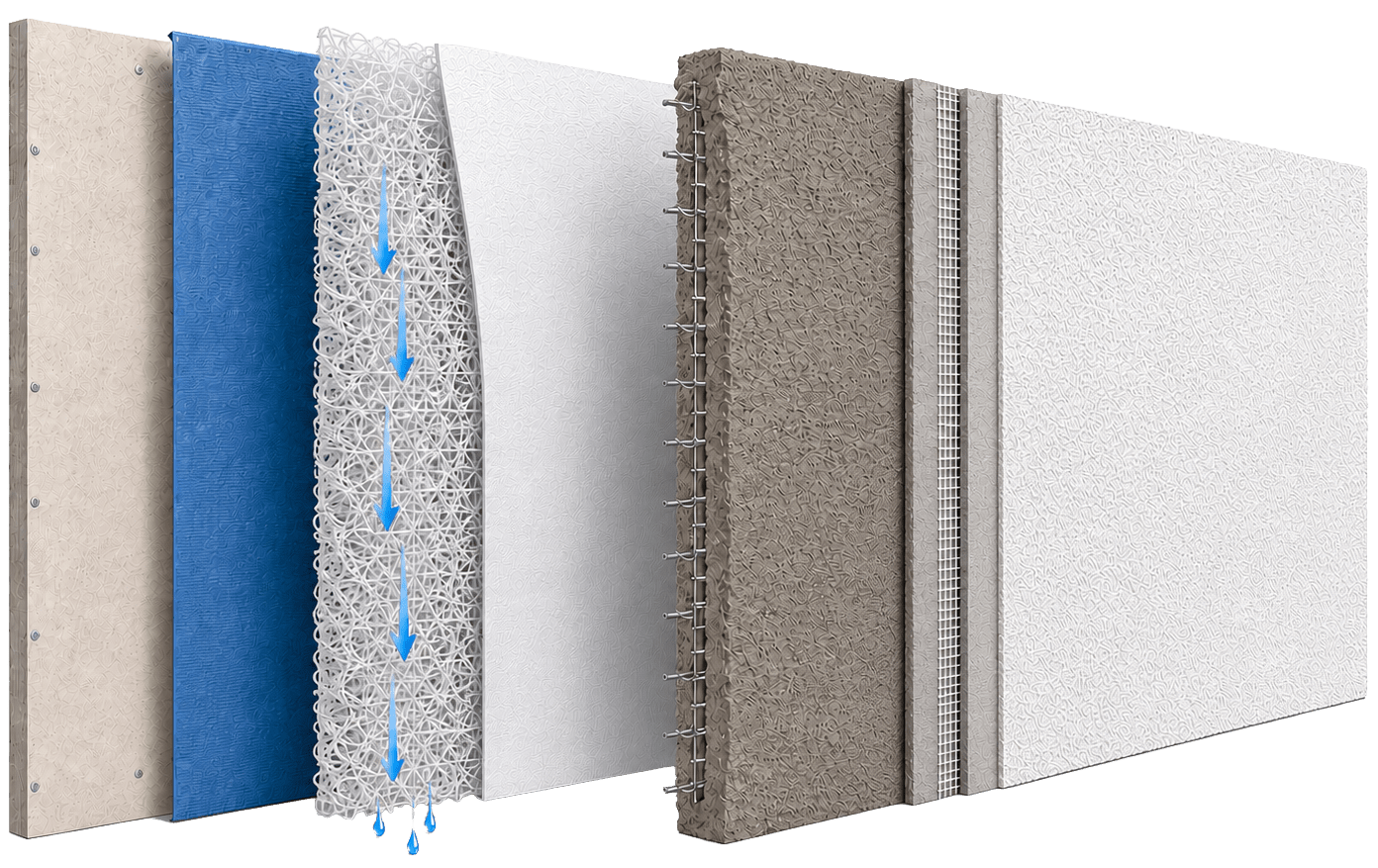
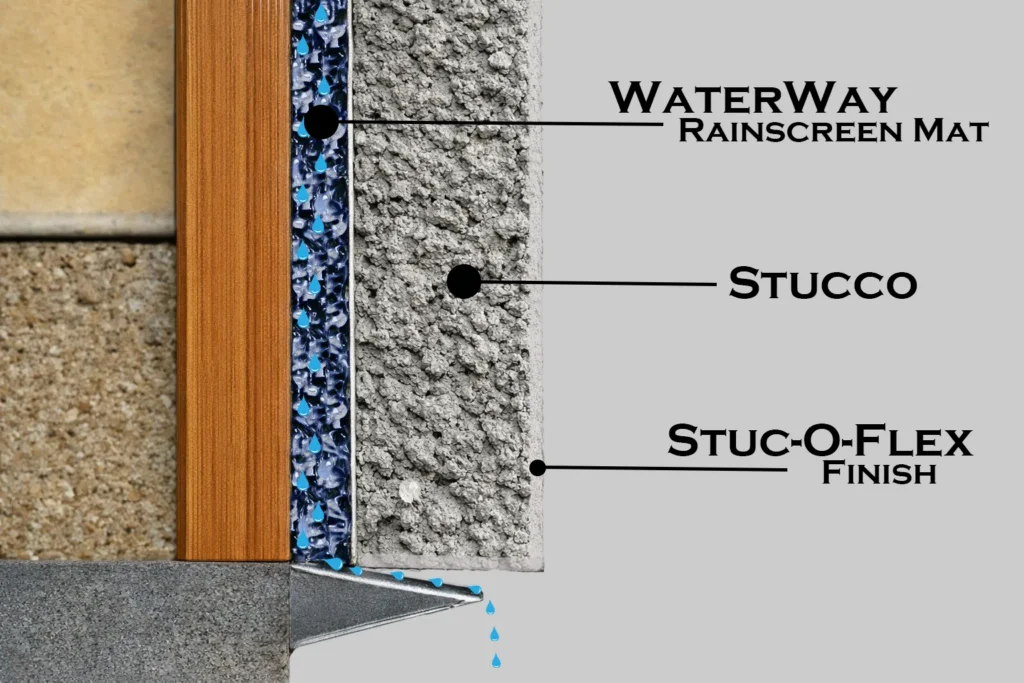
Rainscreen Stucco Assembly

CREATE SPACE BETWEEN
YOUR BUILDING AND THE ELEMENTS

WaterWay Rainscreen Drainage Mats consist of a Nylon / Polymer core of fused, entangled filaments in varying thicknesses from a nominal 1/4 inch to 3/4 inch, depending on desired cavity space and cladding selection. Certain profiles are available with a protective filter fabric bonded to one side or consider WaterWay Plus - a revolutionary “Patent Pending” Drainage Mat consisting of a .45” / 11.4mm thick polymer matrix heat laminated to a breathable filter fabric on one side and a code compliant weather resistive barrier (WRB) on the other side. This multiple layer product creates a one step WRB and Rainscreen drainage assembly in a single application. “WaterWay” Rainscreen Mats are designed for stucco, EIFS, manufactured stone, fiber-cement, brick, lap and cedar sidings and other wall system materials.


FEATURES & BENEFITS:

  • 50 Times more Efficient at Draining Water than a Traditional WRB alone*
  • Redirects Moisture Away from Vulnerable Wall Sheathing Materials
  • Less Expensive than Strapping or Furring
  • Filter Fabric Ensure Cavity Remains Un-Interrupted
  • Green Build Advantage
  • Recycled Content / Adds 3 Leed Points
  • 52 Million Feet in Service
  • Extensive Selection of Profiles
  • Complete Testing, Specifications & Details
  • Exceeds AC-24 drainage criteria for EIFS
  • Promotes Pressure Equalization
  • No Special Skill or Training Required
  • Accommodates 10mm Canadian Code Requirement
  • Reduce Potential Exposure
  • Enhance Consumer Confidence

                                    LEED WATERWAY RATINGS

rainscreen drainage mat
 drainage mat
rainscreen drainage mat
 
rainscreen drainage mat
 
rainscreen drainage mat
 
 
rainscreen drainage mat
  1. Substrate
  2. Weather Resistive Barrier
  3. WaterWay Rainscreen Drainage Mat
  4. Stone Veneer / Cladding

Code Mandates:

Exterior wall envelopes are required to be weather-resistant and provide a means for draining water that enters the assembly.

stucco drainage building
 stucco drainage building
 

SPECIFICATIONS AND DETAILS

Details and Drawings
 
Specifications
 

SIX UNIQUE PROFILES
ACCOMMODATE CLADDING SELECTION & SPACE REQUIREMENTS

waterway drainage mat

WaterWay Plus
environmentally friendly

WaterWay Plus is a revolutionary Patent Pending Vertical Wall Rainscreen Drainage Mat consisting of a nominal 7/16 inch / 11mm thick extruded polymer matrix of tangled monofilaments. The monofilaments are heat laminated to an impenetrable, breathable, filter fabric on one side and a code compliant weather resistive barrier on the other side. This multiple layer product creates a one step weather resistive barrier and rainscreen drainage assembly in a single application. WaterWay Plus is designed for use with manufactured and natural stone, traditional and one coat stucco, EIFS, fiber-cement and wood based sidings, masonry, metal and other wall cladding materials. This rainscreen product provides an un-interrupted drainage path & ventilation for incidental moisture between exterior finish materials and wall sheathing.
Product Data Sheet       Canadian Approval


waterway drainage mat

WaterWay "9714"

WaterWay 9714 is a nominal 3/16 inch thick drainage product consisting of a nylon core of fused entangled filaments and a geotextile fabric bonded to one side. WaterWay 9714 is designed for use with traditional stucco, EIFS, cultured stone, and other wall cladding applications as an exterior wall drain. The rainscreen provides a drainage path & ventilation for incidental moisture between exterior wall finish materials and weather resistive barriers.
Product Data Sheet


waterway drainage mat

WaterWay "9714A"
environmentally friendly

WaterWay 9714A is a nominal 3/16 inch thick drainage product consisting of a polymer core of fused entangled filaments and a geotextile fabric bonded to one side. WaterWay 9714A is designed for use with traditional stucco, EIFS, cultured stone, and other wall cladding applications as an exterior wall drain. The rainscreen provides a drainage path & ventilation for incidental moisture between exterior wall finish materials and weather resistive barriers.
Product Data Sheet


waterway drainage mat

WaterWay "9010"

WaterWay 9010 is a nominal 3/8 inch thick drainage product consisting of a nylon core of fused, entangled filaments and a geotextile fabric bonded to one side. WaterWay 9010 is designed for use with traditional stucco, EIFS, manufactured stone and other wall cladding applications as an exterior wall drain. The rainscreen provides a drainage path & ventilation for incidental moisture between exterior wall finish materials and weather resistive barriers. WaterWay 9010 is also used as a means of relieving hydrostatic pressure from backfills abutting below grade structures, planters and plaza decks.
Product Data Sheet


waterway drainage mat

WaterWay "040"
environmentally friendly

WaterWay 040 is a revolutionary Vertical Wall Rainscreen Drainage Mat consisting of a nominal 7/16 inch / 11mm thick extruded polymer matrix of tangled monofilaments. The monofilaments are heat laminated to an impenetrable, breathable, filter fabric on one side. This multiple layer product creates a one step rainscreen drainage assembly in a single application. WaterWay 040 is designed for use with manufactured and natural stone, traditional and one coat stucco, EIFS, fiber-cement and wood based sidings, masonry, metal and other wall cladding materials. This rainscreen product provides an un-interrupted drainage path & ventilation for incidental moisture between exterior finish materials and wall sheathing.
Product Data Sheet       Canadian Approval


waterway drainage mat

WaterWay
Rainscreen 075
environmentally friendly

WaterWay Rainscreen 075 is a nominal 3/4 inch thick, randomly oriented geometrically patterned drainage and ventilation mat. It is designed to eliminate moisture accumulation and moisture vapor in masonry applications and other siding applications. It is produced from an extruded polymer matrix of tangled monofilaments. The monofilaments are heat welded at the junctions to form a resilient structure that spaces siding away from the inner sheathing. The product is especially useful in masonry where a clear cavity is desired.
Product Data Sheet


HEALTHIER WALLS THROUGH RAINSCREEN & VENTIATION

PUT SOME SPACE BETWEEN YOUR BUILDING AND THE ELEMENTS

Fundamental theory in cladding integrity prevents liquid water from penetrating vertical walls, ideally through appropriate materials selection, architectural detailing and professional installation consistent with specifications and construction documents.

Unfortunately, we can all attest to the increased frequency of problems arising from water infiltration and deterioration in exterior envelopes. Particularly, wood framed buildings constructed to more stringent codes, appear increasingly susceptible to problems unlike older, drafty and un-insulated walls built decades ago. Avoiding deterioration in older buildings is not a consequence of better resistance to water intrusion, but rather a better ability to dissipate moisture. Forensic evaluations note compromise from moisture penetration increase significantly if water is unable to evaporate or drain, causing accelerated consequential damage. Absent perfect design, execution, materials performance and continued maintenance, inevitably problems can develop.


If we are more susceptible to decay, let’s consider requirements for mold growth:

  1. Spores – In wet or humid climates, mold spores are present everywhere.
  2. Temperatures - Generally above 40 degrees F.
  3. Food Source – Most organic materials including wood and paper products.
  4. Oxygen – Even with low permeance building materials.
  5. Water – Varies by species, but growth occurs at levels between 20% - 40%.

  rainscreen drainage mat

Depending on project location and climate, the moisture content of even protected building products may fluctuate at levels just below the minimum required for fungal growth. And if one considers four of the five elements needed for mold development are inevitably present at all times, even a small amount of additional water can result in decay, causing deterioration.

If modern construction techniques reduce water vapor diffusion and agree moisture will likely penetrate outside walls, it is important to incorporate a defensive strategy to mitigate the effects of water intrusion and prevent rot.

  rainscreen drainage mat

CREATE THAT SPACE THROUGH VERTICAL WALL DRAINAGE MATS

WaterWay Rainscreen Drainage Mats provide that additional space for drainage. They also contribute to air circulation and ventilation when properly designed. The combination of water drainage and increased air flow will enhance drying and in turn reduce the damaging effects of water penetration. Building papers and house-wraps are well established in providing some protection against substrate damage. Traditional barriers offer a marginal safeguard, but they do not always provide an adequate path for drainage. With siding materials tightly installed against weather resistive barriers, opportunities for drainage and ventilation can be inadequate or even blocked.

The Building Code (ICC and IRC) mandate:

“Exterior wall envelopes are required to be weather- resistant and provide a means for draining water that enters the assembly”

Engineers and designers are exploring various configurations to accommodate the code and remove water from the exterior walls while incorporating some mechanism of ventilation. Enhancing air flow and managing entrapped moisture make sense; the challenge lies in a simple, efficient and cost effective approach.

From Boston to Seattle, WaterWay drainage mats are finding acceptance with some of the most recognized and distinguished building enclosure specialists in North America. In both new construction and cases of cladding remediation, Drainage Mats accommodate essential criteria in today’s construction environment.

rainscreen drainage mat

“WaterWay Drainage Mats” consist of a Nylon / Polymer core of fused, entangled filaments in varying thicknesses from a nominal ¼ inch to ¾ inch, depending on desired cavity space and cladding selection. Certain profiles are available with a protective filter fabric bonded to one side, even our “Patent Pending” polyolefin-based house-wrap is available with drainage mat attached. “WaterWay” Rainscreen mats are equally effective for stucco, EIFS, manufactured stone, fiber-cement, brick, standard lap and cedar sidings and other wall system materials.

This technique achieves desired results with limited additional expense. The incorporation of WaterWay Rainscreen Drainage Mats can run as little as $.65 a square foot for materials. With varying labor rates it’s difficult to offer a specific cost for installation, although it should not be more that $.95 - $1.50 (labor & materials) per square foot. With over 60 million feet in service and an exponential increase in demand, you can feel confident in this effective concept.

For additional information on the “WaterWay Rainscreen Drainage Mats” including product data sheets, profile samples, test reports, detail drawings, specifications and an animated DVD presentation.

Contact Stuc-O-Flex International, Inc. @ 1-800-305-1045

www.stucoflex.com or e-mail info@stucoflex.com

Note: Surfactants present in some siding materials may decrease water resistance of the secondary moisture barrier if direct contact occurs

WaterWay Drainage Mats in Roofing Applications

Galvanized metal roofing (zinc coated) is common in commercial building and especially susceptible to corrosion. In any climate, moisture can build up under the roof and cause damage to the structure. WaterWay mats can be incorporated as a spacer between the metal and roof sheathing providing a passage for moisture drainage while reducing water accumulation which causes corrosion. In cold weather, a cold roof surface is desirable to prevent the build-up of ice and the problems associated with ice dam backup. WaterWay mats create a thermal break and ventilation layer in the roof where the conduction of heat would normally occur. This characteristic reduces the potential for ice dams


Need a vent layer in commercial roofing?

For many designers the need for a ventilation layer between the roofing shingle or membrane and the insulation has become a standard technique to ensure that moisture does not build up beneath the sheathing. Furring is an expensive way of spacing the insulation from the sheathing and limits ventilation to one direction. This system can now be replaced by a single layer of WaterWay Mat or WaterWay Weather Barrier “5006” designed to reduce roof top temperatures while providing maximum insulation efficiency. The mat is rigid enough to support the full weight of the roof and its open structure allows for multi-directional ventilation. For the contractor, the installation of this lightweight product is easy and quick.