
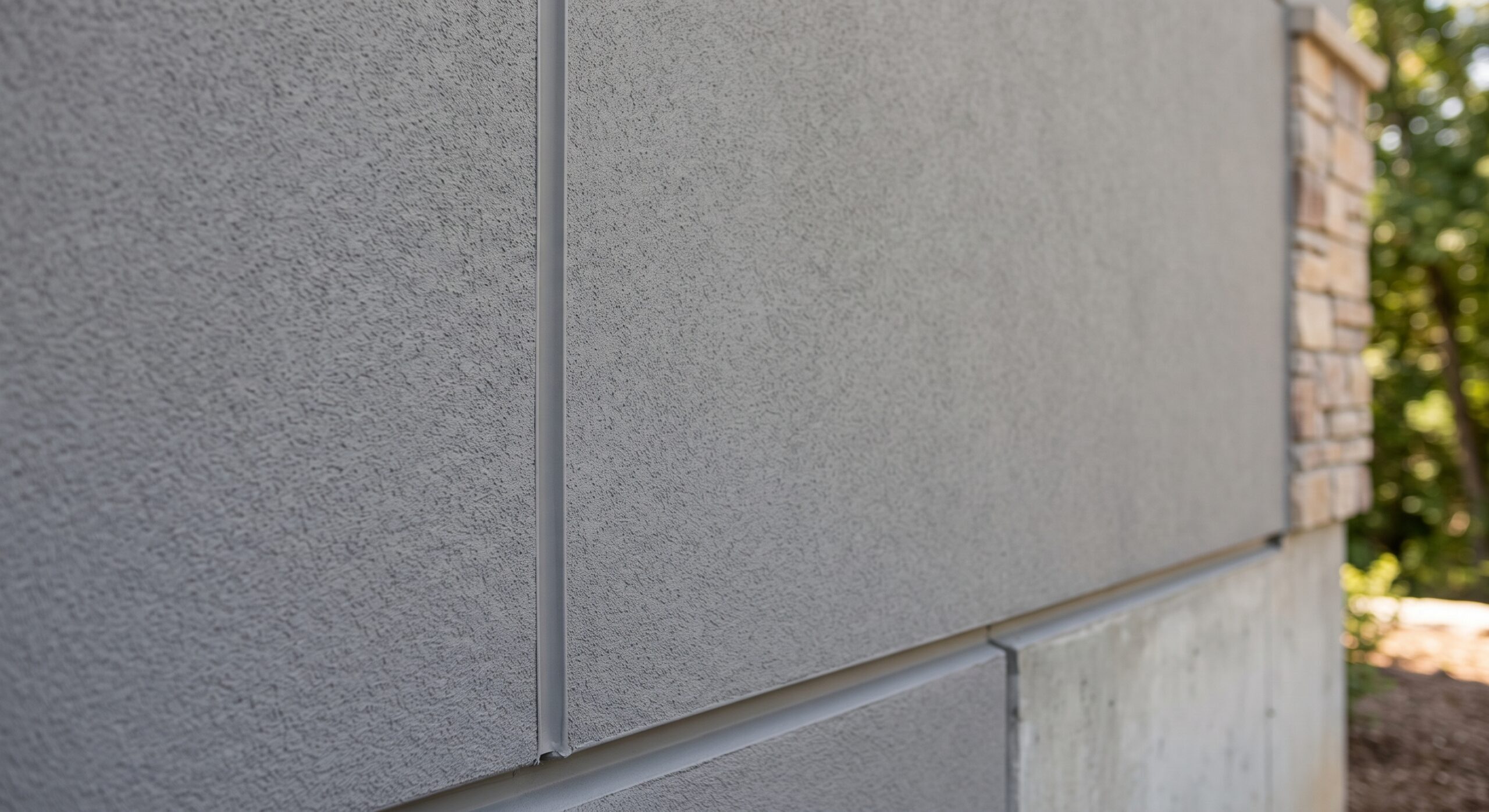
How to Stop Stucco Cracking
Stucco cracks often start long before the finish coat goes on. Substrate preparation, base coat selection, and joint placement all affect how well the system handles movement over time. Getting those details right from the start helps reduce cracking, moisture issues, and costly callbacks.
TLDR
Stucco cracks when the wall assembly cannot absorb the movement working against it, not because of a bad batch of finish coat. Stopping it takes three layers working together: a reinforced base coat that spreads stress, a finish coat with enough elongation to flex instead of splitting, and a drainage plane that keeps moisture from cycling behind the cladding. Expansion joints placed at the correct intervals handle whatever movement those layers cannot absorb on their own. Skip any one layer and the others end up fighting a mechanism they were never designed to solve alone.
Why Does Stucco Crack? The Four Mechanisms
Stucco cracking follows recognizable patterns, and each pattern points to a specific mechanism in the wall assembly. Knowing which mechanism produced a crack tells you which layer failed, and where the fix belongs.
The four primary mechanisms are substrate movement and differential settlement, thermal expansion and contraction cycling, moisture cycling through the substrate, and missing or misplaced expansion joints. On large commercial wall planes, thermal cycling across dissimilar substrate interfaces most commonly drives pattern cracking. On wood-frame construction, missing joints at plate lines concentrate stress at the same locations every time.
Crack Patterns by Mechanism
| Mechanism | Typical Crack Pattern |
|---|---|
| Substrate movement and differential settlement | Diagonal cracks at corners; cracks at dissimilar substrate transitions |
| Thermal expansion and contraction cycling | Map cracking across large wall fields; horizontal cracking at floor lines |
| Moisture cycling through the substrate | Efflorescence-adjacent cracking; surface delamination; staining at crack edges |
| Missing or misplaced expansion joints | Straight vertical or horizontal cracks at predictable stress points |
Recognizing the pattern narrows the diagnosis quickly. Mapping cracking across a wall field points to finish-coat elongation failure. Diagonal cracking at corners points to substrate movement that a finish coat change alone cannot solve.
Where Expansion Joints Go
Expansion joints are the primary mechanical accommodation for substrate movement in a stucco assembly. Placed incorrectly, or omitted, they concentrate stress in the finish coat at predictable locations. The governing specification is explicit about when a joint is required.
The Four Conditions That Require a Joint
- Where dissimilar materials abut, such as the transition from concrete masonry to wood-frame sheathing, or from a steel beam to a stucco field.
- In conjunction with building expansion joints, wherever the structure itself is designed to accommodate movement.
- Not exceeding 144 sq ft of wall surface, which sets the maximum interval for control joint spacing across a continuous field.
- Where extreme structural movement may occur, particularly at plate lines in wood-frame construction.
These conditions are not independent. A plate line that also crosses a dissimilar substrate interface requires a joint on both grounds.
What Governs Control Joint Spacing on a Real Elevation
The 144 sq ft interval is a maximum. Apply it by calculating the area of each continuous stucco field between existing interruptions: windows, doors, corners, and structural joints. Any field that exceeds 144 sq ft requires a control joint placed to divide it below that threshold.
On a 12-foot wall, a continuous horizontal run reaches 144 sq ft at 12 feet. On a 10-foot wall, the run extends to roughly 14.4 feet before a joint is required. Plate lines in wood-frame construction are always joint locations regardless of area, because the structural discontinuity at the top plate concentrates movement that the finish coat cannot bridge on its own.
Full CSI specification detail on joint placement and wall assembly requirements is available in our specifications library.
Five Field Conditions That Cause Callbacks
Most callbacks trace to a small set of field conditions, each with a documented threshold or procedure that eliminates the failure mode when followed.
Substrate Moisture Above the Documented Threshold
Moisture content of the stucco shall not exceed 19% at the time of finish application. A finish coat applied over a wetter substrate traps moisture beneath the film; as the substrate dries and contracts, it transmits stress directly into the finish coat from below. The result, delamination or surface cracking within weeks, is often misdiagnosed as a product failure. Measure substrate moisture before scheduling the finish coat.
Cold-Weather Application Without an Adequate Temperature Hold
Ambient temperatures shall be 40F or greater at installation and remain so for a minimum of 24 hours. Applying below that threshold, or where temperatures drop below 40F within 24 hours, prevents proper film formation. Adhesion is compromised, and the wall is vulnerable to freeze-thaw damage before the film develops its rated performance. Check the full 24-hour forecast before scheduling.
Inadequate Cure Time Between Coats
Rushing the base coat cure to hold a schedule compresses the window during which the base coat reaches full strength and moisture equilibrium. A finish coat applied over an undercured base coat bonds to a surface that is still changing dimensionally, and moves with it in ways the finish chemistry was not designed to accommodate at that scale. Verify moisture content as the indicator of readiness.
Missing or Undersized Expansion Joints
A joint at the wrong location, or too narrow for the movement it needs to absorb, becomes a stress concentration rather than a stress relief. Joints filled solid with sealant before they can move, or spaced beyond the 144 sq ft maximum, leave the finish coat to absorb movement the assembly was designed to release. Confirm joint placement against the four required conditions before the base coat goes on.
Substrate Surface Contamination Preventing Bond
The substrate must be clean, dry, above freezing, and free of loose or foreign material: rust, mildew, dust, dirt, form breaker, and oils. Contamination creates a bond-breaking layer between the base coat and the wall. It appears to adhere during application but separates under thermal or moisture stress, taking the finish coat with it. On restoration projects, residue from previous coatings or form-release agents is a common source of adhesion failure.
Crack Resistance Starts With the Base Coat
The finish coat cannot compensate for a base coat that fails to distribute stress across the substrate. Crack resistance starts at the base coat layer, and its role is more than adhesion.
A polymer-modified base coat creates a uniform bonding surface that reduces porosity variation across the substrate. Porosity variation means different sections of the wall absorb moisture from the finish coat at different rates, producing uneven cure, color variation, and differential shrinkage stress. A consistent base coat gives the finish coat a consistent platform to cure against.
Fiberglass reinforcing mesh embedded in the base coat distributes tensile stress across the wall field before it can concentrate at a single point. When the substrate moves, the mesh spreads that movement over a broader area, reducing the peak stress that reaches the finish coat. Without mesh reinforcement, stress concentrates at weak points in the base coat and propagates directly into the finish layer.
Matching Base Coat and Mesh to the Substrate
Substrate variability is one of the most common sources of base coat performance problems on commercial projects. A base coat that performs correctly on concrete masonry may need a different application approach on expanded polystyrene or cement board, because absorption, surface texture, and dimensional stability differ across those substrates.
Stuc-O-Base is a wet-mix concentrate mixed 1:1 by weight with Portland Cement, used as an adhesive and underlayment for acrylic finish coatings. It has good adhesion to stucco, concrete, cement board substrates, block, brick, expanded polystyrene, and polyisocyanurate foams. It is applied at a nominal 1/16 to 1/8 inch with fiberglass reinforcing mesh embedded immediately into the wet base coat, and covers approximately 180 square feet per container once mixed 1:1 with Portland Cement. Stuc-O-Base carries an ASTM E-84 surface burning rating of flame spread under 25 and smoke development under 450.
On renovation projects with variable existing substrate, the base coat creates a surface the finish coat can read as uniform. On new construction where multiple substrate types meet at transitions, the base coat bridges those differences before the finish coat goes on.
Full product data and substrate compatibility documentation: base coats product page.
How an Elastomeric Finish Accommodates Movement
A finish coat that cannot flex with the building will crack when the building moves. That is the entire argument for elastomeric chemistry in exterior stucco. The question is how much movement it accommodates, and what the data shows.
The Stuc-O-Flex Elastomeric Acrylic Finish exceeds 105% elongation. In practical terms, the finish coat can stretch to more than twice its original dimension and recover without rupturing. The 1/8-inch mandrel bend test without rupture confirms the film holds integrity under sharp directional stress, the kind that occurs at corners and at the edges of expansion joints.
ASTM Performance Data
| Test | Standard | Result |
|---|---|---|
| Elongation | ASTM testing | Exceeds 105% |
| Mandrel bend | Field test | 1/8 inch without rupture |
| Accelerated weathering | ASTM G-23-81 | 2,000 hours |
| Salt spray resistance | ASTM B-117 | 300 hours |
| Freeze-thaw cycling | Field test | 60 cycles |
| Fire rating | ASTM E-84 | Class A; flame under 25, smoke under 450 |
| Bond strength | ASTM C-297 | 127.9 PSF |
These figures describe the finish coat performing on a correctly prepared substrate. Elongation capacity addresses thermal cycling and substrate movement. The 2,000-hour accelerated weathering and 300-hour salt spray results address long-term durability in coastal and high-UV markets. The 60 freeze-thaw cycles confirm performance in cold-climate markets with significant seasonal cycling.
Full technical data: product data sheets. Complete specification: Stuc-O-Flex Elastomeric Acrylic Finish.
Moisture Management as Crack Prevention
Moisture cycling through the substrate is a crack mechanism. Water that infiltrates behind the finish coat expands the substrate as it is absorbed and contracts it as it dries, transmitting stress to the finish coat from the back side, independent of any thermal or structural movement happening at the same time. Managing moisture behind the cladding is a direct crack-prevention measure.
A drainage plane behind the stucco assembly gives water that penetrates the face coat a path to exit rather than accumulate against the substrate. Without one, that water either evaporates back through the finish coat, slowly, keeping the substrate wet longer, or migrates through the base coat into the wall assembly, causing progressive moisture damage.
The Drainage Mat’s Role
The WaterWay Rainscreen Mat creates a continuous drainage and ventilation cavity between the weather-resistive barrier and the stucco assembly, giving bulk water a clear downward path and letting the wall dry from both sides. WaterWay exceeds 247 perms moisture vapor transmission per ASTM E-96, drains 50 times faster than standard weather resistive barriers, and meets or exceeds ICC/IRC AC-38 acceptance criteria.
The wall assembly sequence with WaterWay installed is: substrate, weather-resistive barrier, WaterWay drainage mat, base coat with reinforcing mesh, and elastomeric acrylic finish coat. CSI Section 09 24 00 / 09220 governs the WaterWay Rainscreen Stucco Assembly specification.
The drainage cavity interrupts the moisture cycling mechanism before it reaches the finish coat. A finish coat on a continuously wet substrate is under constant stress from below. The same finish coat on a properly drained substrate performs the way its ASTM elongation data was measured: accommodating movement from thermal and structural sources, rather than fighting moisture expansion from behind at the same time.
More on moisture and long-term wall performance: common moisture problems in stucco walls.
The Three Layers Together
Every crack mechanism above maps to a specific layer of the wall assembly. Substrate movement and thermal cycling are addressed by the finish coat’s elongation capacity. Stress concentration is addressed by the base coat and reinforcing mesh, which distribute load before it reaches the finish layer. Moisture cycling is addressed by the drainage plane, which removes the source of back-side stress before it accumulates. Movement the assembly cannot absorb on its own is addressed by expansion joints placed per spec.
No single product stops stucco cracking. The system does, because each mechanism needs a response at a different layer. A finish coat with exceptional elongation on a poorly drained substrate is still fighting moisture cycling from below. A well-drained wall with an undersized base coat still concentrates stress at transitions. The assembly works when all three layers, plus correctly placed joints, are specified together.
This is why we manufacture all three layers: the base coat and reinforcing mesh, the Elastomeric Acrylic Finish, and the WaterWay Rainscreen drainage assembly. A contractor or specifier sourcing each layer from a different manufacturer is assembling a system whose parts were never tested together. We build the complete assembly and stand behind its documented performance as a system.
For application guidance and technical support, see our contractors resource page. For CSI documentation and wall assembly drawings, see our architects resource page and specifications library.
Frequently Asked Questions
How do I select the right base coat and mesh for a given substrate?
Stuc-O-Base is documented for stucco, concrete, cement board, block, brick, expanded polystyrene, and polyisocyanurate foams. The key variables are surface porosity and dimensional stability. Porous substrates like CMU need thorough prep before the base coat goes on. Foam substrates need it applied at a nominal 1/16 to 1/8 inch, with mesh embedded immediately into the wet coat.
What are the cold-weather application requirements?
Ambient temperatures shall be 40F or greater at installation and remain so for a minimum of 24 hours, for both the base coat and finish coat. Check the full 24-hour forecast before scheduling. Supplemental heat and enclosure can allow application in borderline conditions, but the temperature hold requirement still applies.
How do I calculate expansion joint spacing on a specific elevation?
Map the elevation and identify existing interruptions: windows, doors, corners, structural joints, and dissimilar substrate transitions. Calculate the area of each continuous stucco field between them. Any field exceeding 144 sq ft requires a control joint placed to divide it below that threshold. Plate lines in wood-frame construction require joints regardless of area.
What should I do on a wall that already has movement-related cracking?
Confirm the mechanism before any surface repair: map cracking points to a finish coat elongation issue, diagonal corner cracks point to substrate movement, and straight cracks at predictable intervals point to missing or mislocated joints. Applying a surface coating over active substrate movement or missing joints produces a second failure at the same spot. For the repair path once damage is confirmed, see our crack repair guide, exterior stucco crack repair walkthrough, and stucco restoration overview.
Which data sheet should I pull for a project submittal?
For a standard WaterWay Rainscreen Stucco Assembly submittal, pull the WaterWay 7mm data sheet, the Stuc-O-Base data sheet, and the Stuc-O-Flex Elastomeric Acrylic Finish data sheet. CSI Section 09 24 00 / 09220 covers the complete assembly and governs the submittal package. All current data sheets and the CSI specification are on our product data sheets page and specifications page.
Technical Support and Specification Documents
If you are working through a submittal package or evaluating the Stuc-O-Flex system for a commercial or multi-family project, our technical team can walk you through product selection, application sequencing, and CSI documentation.
Call 1-800-305-1045 or email [email protected].