
What Is Elastomeric Paint? A Technical Guide for Contractors
When specifying an exterior coating, the goal is always long-term performance. You need a finish that not only looks good on day one, but also withstands years of building movement, weather exposure, and wear. While traditional paints offer color, they often fall short in durability, quickly showing hairline cracks as the structure settles. This is where a specialized category of coating provides a better solution. Elastomeric paint is an engineered protective layer designed to flex, breathe, and protect the building envelope in ways standard paints cannot. This guide covers what elastomeric paint is, how it differs from traditional latex paint, and when to specify it.
TLDR
Elastomeric paint is a high-build, high-performance acrylic coating engineered to stretch and return to its original shape, applied at 10-15 wet mils per coat versus the 3-5 wet mils of standard latex paint. That extra film build is what lets it bridge hairline cracks: Stuc-O-Flex Finish tests at 105% elongation and Renew at 305% elongation per ASTM D 2370, with 98% elongation recovery, 2,000 hours of accelerated weathering per ASTM D 4587, and performance down to 40F with 60 freeze-thaw cycles. Standard coatings often fall short in durability and may not adequately bridge the movement elastomeric coatings are built to handle.
What Is Elastomeric Paint?
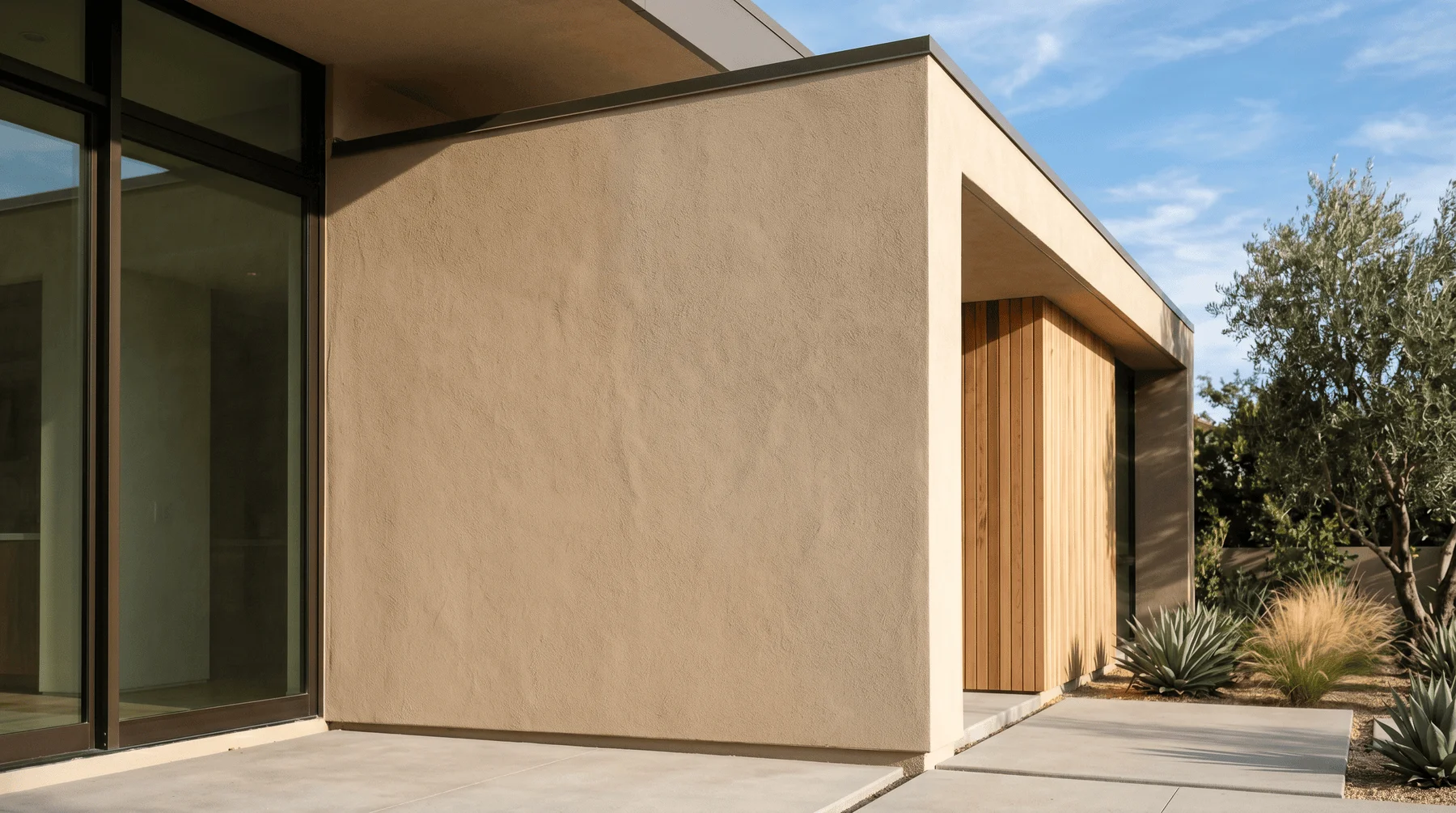
At its core, elastomeric paint is a high-build, high-performance acrylic coating engineered to stretch and return to its original shape. Unlike regular latex paint, it is applied in a thick film, typically 10-15 wet mils per coat, creating a durable, flexible, and water-resistant membrane over the substrate. Its high acrylic solids content and specialized formulation allow it to achieve significant elongation, with Stuc-O-Flex Renew testing at 305% elongation per ASTM D 2370, enabling it to bridge existing non-structural hairline cracks and prevent new ones from telegraphing through the finish. It is also breathable, allowing moisture vapor to escape from within the wall assembly and preventing blistering and peeling while blocking wind-driven rain. For this reason, it is the ideal coating for dynamic substrates like stucco, concrete, and masonry that experience thermal expansion and contraction.
How Elastomeric Paint Differs from Traditional Latex Paint
It’s a common misconception to think of elastomeric paint as just a thicker version of standard exterior paint. The two are fundamentally different in their chemical composition, application thickness, and performance characteristics. Where traditional latex paint provides a thin, decorative layer, an elastomeric coating provides a robust, functional membrane engineered for protection and longevity.
Understanding these differences is key to specifying the right product for the job.
| Feature | Elastomeric Coating | Traditional Latex Paint |
|---|---|---|
| Film Thickness | 10-15 wet mils per coat | 3-5 wet mils per coat |
| Flexibility | High (Stuc-O-Flex Finish: 105%; Renew: 305%) | Low (becomes rigid and brittle) |
| Crack Bridging | Yes, bridges existing hairline cracks | No, will crack over moving joints |
| Breathability | High (allows vapor to escape) | Varies, often much lower |
| Water Resistance | Excellent (resists wind-driven rain) | Moderate |
| Primary Function | Protection, waterproofing, crack prevention | Decoration, color |
| Ideal Substrates | Stucco, concrete, masonry, EIFS | Wood, primed metal, stable surfaces |
How Stuc-O-Flex Differs from Retail Elastomerics
Traditional exterior latex paints are primarily designed to color and protect a surface, but many can become rigid over time and may not adequately accommodate the natural movement found in stucco and masonry assemblies. As a manufacturer focused specifically on exterior stucco systems, Stuc-O-Flex coatings are engineered with enhanced flexibility, breathability, and thicker film build characteristics to better perform over stucco substrates.
For repaint, recoat, and touch-up applications, Stuc-O-Flex flexible finishes help bridge hairline cracks while still allowing moisture vapor to escape, helping reduce cracking, peeling, and moisture-related failures commonly associated with more rigid coating systems. Unlike conventional paints developed for broad exterior use, Stuc-O-Flex products are purpose-built for the long-term performance demands of stucco wall systems.
For larger or more active cracks, Stuc-O-Flex also offers complementary repair products specifically designed for crack remediation prior to recoating. As a paint-grade example, Stuc-O-Flex Renew is tested at 305% elongation per ASTM D 2370 with 98% elongation recovery, and is applied at 10-15 wet mils per coat to build a thick, flexible film engineered for active stucco substrates.
What Is Elastomeric Paint Made Of?
The unique properties of elastomeric coatings come from their advanced formulation. While specific ingredients vary by manufacturer, high-quality systems are built on a few core components that work together to deliver flexibility and durability.
- 100% Acrylic Polymer Binders: This is the backbone of the coating. A high concentration of pure acrylic polymers provides exceptional flexibility, adhesion, and long-term durability. Unlike coatings that use vinyl or other fillers, 100% acrylic formulations resist breaking down under UV exposure, ensuring the paint remains flexible for decades.
- High Solids, Thick Film Build: Premium elastomeric paints are applied as a thick film membrane, not a thin decorative coat. Stuc-O-Flex Renew, for example, is applied at 10-15 wet mils per coat. This denser film is what creates the flexible, seamless membrane that bridges hairline cracks and resists wind-driven rain.
- Factory-Integrated Colorants: To ensure vibrant, long-lasting color, pigments are added during the manufacturing process. This results in a finish that is highly resistant to fading and chalking, even after years of sun exposure.
- Internal Plasticizers: Flexibility is built directly into the polymer structure. This is a critical distinction from cheaper products that rely on additive plasticizers, which can leach out over time and cause the coating to become brittle.
Key Benefits of Specifying Elastomeric Coatings
Choosing an elastomeric coating over a standard paint provides tangible performance advantages that protect the building envelope and reduce long-term maintenance costs.
- Superior Crack Bridging: Its ability to stretch and flex allows it to move with the building, sealing existing non-structural hairline cracks and preventing future cracks from telegraphing through the finish.
- Exceptional Water Resistance: The thick, seamless membrane is highly resistant to wind-driven rain and water penetration, protecting the underlying substrate from moisture damage.
- Engineered Breathability: While it blocks liquid water, it allows trapped water vapor to escape. This high rate of moisture vapor transmission is critical for preventing blisters, peeling, and moisture-related decay within the wall assembly.
- Long-Term Durability: A high-quality elastomeric finish is formulated to resist mildew, dirt pickup, and degradation from UV radiation and salt spray, ensuring the building maintains its aesthetic appeal for years.
- Reduced Lifecycle Costs: Although the initial material cost is higher than traditional paint, the extended service life and reduced need for frequent repainting and crack repair can result in a lower total cost of ownership over the building’s lifespan.
When and Where to Use Elastomeric Paint
Elastomeric coatings are the ideal solution for vertical, above-grade exterior surfaces that are prone to movement, cracking, or intense weather exposure. They excel in climates with significant temperature swings or high humidity.
Ideal Applications Include:
- Stucco: Both traditional Portland cement plaster and one-coat stucco systems.
- Concrete & Masonry: Poured-in-place concrete, tilt-up panels, and concrete masonry units (CMU).
- EIFS: As a refresh coating to restore color and add a protective layer to aging Exterior Insulation and Finish Systems.
- Fiber-Cement Siding: To provide a flexible, water-resistant finish over primed siding.
It is important to note that elastomeric coatings are not designed for horizontal surfaces like decks, patios, or walkways that are subject to foot traffic. They are also not intended for use on surfaces below grade.
Common Questions About Elastomeric Coatings
Won’t a high-quality exterior latex paint work just as well on stucco?
Traditional exterior latex paints can become rigid over time and may not adequately bridge movement-related cracking in stucco and masonry applications. Stuc-O-Flex systems are engineered with high flexibility, breathability, and thicker film build characteristics that help bridge hairline cracks while still allowing moisture vapor to escape. This combination helps reduce cracking, peeling, and moisture-related failures commonly seen in rigid coating systems.
Is elastomeric paint waterproof?
No. A properly formulated elastomeric paint is water-resistant, not waterproof. It blocks liquid water from penetrating the surface while staying breathable, so vapor can escape from inside the wall. A truly waterproof coating would trap moisture and cause blistering, peeling, and substrate decay.
Can elastomeric paint be applied over existing paint?
Yes, over compatible acrylic-based coatings, if the existing surface is clean, dry, and well-adhered. Loose or peeling paint must be removed and the surface properly prepared per the manufacturer’s instructions before recoating.
How long does elastomeric paint last?
A manufacturer-grade elastomeric paint, properly applied, can last decades. Actual service life depends on substrate, climate, and application quality. Stuc-O-Flex Renew withstood 2,000 hours of accelerated weathering per ASTM D 4587 with no deleterious effects.
Can elastomeric coatings be used in cold or freeze-thaw climates?
Yes. Their flexibility accommodates thermal expansion and contraction without cracking. Stuc-O-Flex Renew passed 60 freeze-thaw cycles with no cracking or checking. Application temperatures must remain above 40°F during installation and drying.
Does an elastomeric coating waterproof a basement wall or below-grade surface?
No. Elastomeric coatings are designed for vertical, above-grade exterior surfaces. Below-grade waterproofing requires a different product category.
Ready to Specify a High-Performance Coating?
Choosing the right elastomeric coating is about more than just color; it’s about specifying an engineered system that guarantees long-term performance. Since 1988, Stuc-O-Flex International has manufactured elastomeric acrylic finishes trusted on projects across North America. Our systems are formulated for maximum flexibility, breathability, and durability.
If your project demands a finish that can move without cracking and protect the building envelope for decades, our team is here to help. Call the Stuc-O-Flex technical team at 1-800-305-1045 to request technical data, discuss system specifications, or find a distributor in your region. Product data sheets, CSI specs, and ASTM test reports are available at stucoflex.com/resources/.